The Spring Tide: Chapter 6
In which Olaf lacks tact and spills a drink

EPUB & PDF samples available at willdowlingwriter.com
Register here before July 25, 2026 for a free Advance Reader Copy!

1 August 1069
As my family crowded round, I wished I’d had a bath and a meal. It shamed me that my stomach clawed my attention from my kin, and they embraced little more than a stained mantle. My blinded eye drew things from them: tears, confusion, trembling hands.
As always, Gyldas knew me best. “This was clever of you.” He pulled back from the hug and patted the blind side of my face. “Now nobody will notice your nose.”
My white eye laughed its first tear.
When I’d been welcomed by everyone—or when my stink drove them off—home returned to me. A hot tub and soap scrubbed me human. For a week I was only given thin, salty broth, so my half-starved guts wouldn’t burst. Then I ate enough hot bread and green cheese to finally pull my belly from my backbone. The air was thick and warm with stories.
Karl and his watchers hadn’t seen me moving with the work crew. Perhaps we were just unlucky; perhaps I’d been unrecognizable. They’d scoured the city until Renaud taunted them that the wergild was settled: the murderer rotted in a cell beneath the fort. Karl had not accepted that. He’d made other plans.
I learned too that Audra had been right. Tova was with child. She and Halfdan had wed not long after I’d left.
“I’ve read the stars as Bede teaches,” I told her. “You’ll have a dozen daughters, each lovelier and cleverer than the last.” She called me a liar, but I prayed my words would come true.
Halfdan told me no stories, nor did Baldwine. They’d quit the hold and sworn their swords to Edgar Aetheling. When the rebels last marched on Eoforwic, Karl had stood aside, keeping to his merchant’s business. This time he’d joined them. To save me. There was no turning away now.
***
Eoforwic drowned the senses like Eastertide come in autumn. Thousands of boots trod the boardwalks. The streets were loud with hoofbeats and the grinding of wheels. Laughter and songs swam through the smoke of roasting meat. Edgar’s forces had reached the walls: King Malcolm’s Scots, crossbowmen from Flanders, and the rebel English led by thegns like Gospatric and Siward: columns of mail-clad fyrdmen and of poorer ceorls bearing wood-axes or hunting bows or spears. Eoforwic had joined them. Now the Normans were penned in their forts, praying for deliverance.
“You’ll like Siward.” Karl set our pace. The energy in the air gripped his bones. “Arkil needs a fight, I feel. Since the Normans haven’t given one yet… make sure I mind my manners, lad.” I hadn’t seen him like this since he’d marched with King Harold. We each wore a padded green jacket cut to midthigh; the sort that could serve as armour, or if a man was rich, as padding beneath his mail. Karl had left his mail in the attic. Instead, he covered his jacket with the cloak he’d worn as Earl Godwine’s huscarl, rich red wool bordered with golden crosses.
We reached the manor. We hadn’t moved from the tenement yet; Karl would have a place like this again, surely, after we threw the Normans across the Humber.
The grand hall was more somber than the streets. Pottages hung above the hearth, a hog turned on a spit, but at the long tables, men did not feast. They ate, and planned.
Siward was young, blond, and broad as a bear. I saw at once what Karl had meant. This was a man who’d always have shields at his side. And Arkil would always have a knife in his hand. He waved one now, bidding me speak. “You were in the northern fort, I hear. Tell us what you saw from your cell.”
From my cell I’d seen only night skies and leering Normans. “First I worked in the yard, fixing the fort, shoring it up. Then we were taken through the city.” I spoke of troop numbers, schedules, the stretch of palisade that sagged because they’d dug the prison pits too near the wall; anything I’d want to know before storming the gates. I didn’t tell them I’d feared being sold into slavery. I didn’t tell them anything I feared.
“Then my friend Ketill told me he knew your forces were coming. So we planned our escape.”
It splintered my ribs to see that Ketill’s name brought nothing to Arkil’s eyes. I hoped Offa remembered him, at least. I hoped someone killed Tancred.
Arkil turned to Siward. “Nothing we didn’t learn from Renaud.”
Siward said something about cells and work yards, but it skirled past my ears.
“Renaud? He’s been put to the question?” I looked at Karl and saw his tight jaw, his nostrils flaring like a bull’s.
Siward frowned. “Nothing of the sort. He’s joined Gospatric’s camp. I’m told he’s been quite helpful.”
“Yes. Renaud has.” Arkil twitched his head toward the door. “Take a trencher, if you like.”
I hadn’t come for broth and bread. I shoved myself up from the bench. So did Siward. Lucky for me. If he hadn’t stood so quickly, clapped my shoulder in thanks, and walked us to the door, I might’ve found myself facing another death sentence.
***
Karl and I sat by the docks. There were few ships; no sign yet of the Danish fleet. The Aetheling had sailed to meet with them, my kinsmen at his side.
“You didn’t know,” I said.
“No.” Karl leaned his hand on a piling. “Perhaps it’s not so bad. That Renaud knows how to stay on the winning side. If he’s joined Gospatric, maybe we’ll have an English king by Yule.”
“He didn’t pick the winning side at Stamford.”
“Well. In the end, King Harold didn’t win, did he?” Karl’s eyes were fixed downriver, where Vatndreki had berthed. “Renaud sided against Tostig, though. I marked him then. Swaggering about, proud as a new-made thegn. Don’t know what he gained from it.” Mirth pushed the mourning from his eyes. “Must’ve been a lot to put up with those Mercian brothers who led them. If Morcar was on fire, I’d throw him a log and piss on Edwin.”
“He sided against me. And I won.”
Karl pulled me into a crushing one-armed hug. “No bonds can hold you, eh? You know.” He coughed and smoothed his moustache. “You know. When I first learned of you. When I saw you at Dunholm. I knew you’d be like her.”
My mother was rarely spoken of at the hold. Halfdan was too young to have known her well, and when I asked Elswyth, she’d only give a quavering reminder of how many chores needed doing. I didn’t know what abbey she’d served. I didn’t even know whether she’d taken vows after I was born, or before.
The arm started to slip away. I grabbed his shoulder, trying to hold it.
“I should’ve found a way to get you out. A man’s hold is his, to keep together. Until your children can stand on their own. And how do you know?” Karl sighed. “My father had eight sons. Scattered us to the winds. I gave Alden a farm, Drefan his dyeworks in Lunden, Cynric his ship, and thought they’d be all right.”
I hardly knew my distant uncles, but they sent letters. Elswyth read them to Karl sometimes. They’d fared better than Cynric. But none had climbed as high as Karl had, with the edge of his axe.
“Father Marsten said the same. He hopes I have difficult children.”
Karl snorted. “What does he know about difficult? He only has sons.” He shook his head. “I know you want to know about her. She… I should’ve found a way to get her out, too. That’s all.”
I would not look weak in front of Karl. I could not make him look weak in front of me. So I nodded, and we spoke of rebellion.
***
Without Halfdan to humble me, it was hard to know how well I fought one-eyed, but I felt good about it. Smashing walls for the Normans, I’d learned to aim without my right eye; I could swing an axe or sword. My blind side was a weakness, even if I kept my head moving, but in a shieldwall I’d be all right. I still threw spears better than anyone in the practice yard, and my arms could’ve bent a bow of bronze. Not that I’d hit much. I’d never been much good with a bow.
The Aetheling hadn’t yet returned from his mission to the Danes, but he had a base in town near the river. I walked there alone. Gyldas hadn’t wanted to come. “I won’t hold a shield for the men who burned Dunholm,” he’d said. “You don’t have to fight either. You’re already free.”
“When I was in prison, the men still fought. But they only ever fought each other.” I thought he understood what I meant.
The manor’s grounds felt windblown and bare. A pot of glue boiled above a fire, stinking of fouled meat. Vests of half-tanned leather hung on racks, stuffed with straw so they held the shape of a man’s torso. Four men worked around the pot: one stirring, another pouring sand and gravel into the glue. They brushed this slurry across the surface. The fire’s heat baked the glue to a glassy, pebbled finish on the armour.
I walked past the limewashed hall toward the sparring ring, where a group of men were drinking around a fire; mostly Scots, their legs wrapped ankle-to-knee. Some sharpened blades that didn’t seem to need it, while others polished the whorls etched on their weapons and finery.
I walked towards the most English-seeming man—he had the shortest hair, shortest beard, and longest mail coat. I breathed deep and announced myself as I’d rehearsed.
“I am Olaf Halfdansson. My grandfather is Karl Hardfarí, and my kin, Halfdan and Baldwine, are sworn to Edgar Aetheling’s service. I come to serve him too.”
The man didn’t look me up and down. His eyes were fixed on my face. “I know them. What would Edgar do with you?”
I wore a helm, a shield on my back, and an axe on my belt. What did he think? “I’ve come to fight for him. This is a war, isn’t it?”
The Scots must’ve understood. I wasn’t sure if they laughed at my words or the officer’s, until he answered.
“King Edgar doesn’t need the shield arm of a half-blind cripple.”
Their laughter made me want to draw my axe. “I’ve trained to serve in the fyrd, same as any man.”
“A fyrdman, are you? I think not. You would’ve ridden here.”
My head swam and prickled like it was boiling. The warriors of the fyrd were rich men, furnished with spear and shield, helm and mail, and a horse to ride to battle. When we had an English king, those fyrdmen kept the king’s peace. Any free Englishman could be called to support the fyrd, so most trained with them; all had to know soldiering. And I did.
“My kin—”
“Would’ve brought you with them, if they wanted you there.”
These rebels had burned Dunholm. My boyhood home. And still, I’d come to serve them. I imagined snapping their bones like timbers, smashing their teeth to dust. But we were allies. So I didn’t swing my axe.
I swung my leg instead. I whirled and booted the ale barrel, spilling it into the fire. Wet logs scattered and sweet-smelling steam blasted over the Scots. The men reeled back, cursing in more than one tongue. As the steam hissed away, I raised my hands to my mouth and sculpted a gasp on my face. “Oh—dear Lord! Why, I didn’t even see it there!”
Men scrambled up, cursing, hands scrabbling at their belts. I backed away, ready to run.
A horn-blast echoed from the river and blew our quarrel away. All eyes left me. Everyone rushed to the palisade. We stared toward the Ouse.
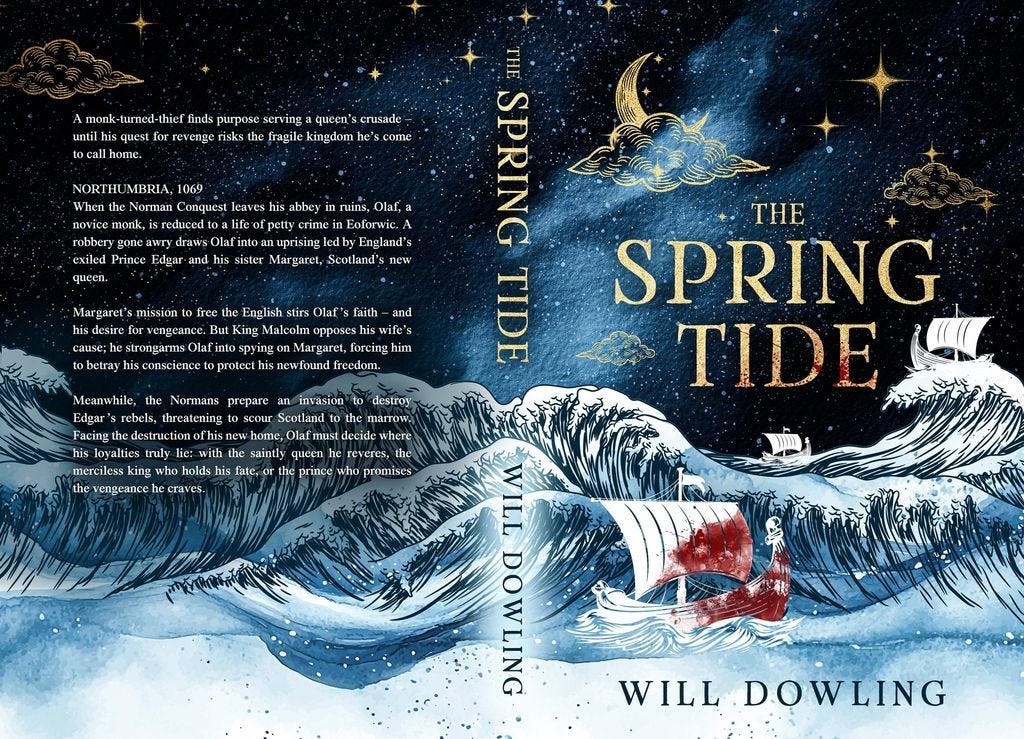
I’d never seen so many ships. So many masts; it looked more like a forest than a river.
The Danes had come.
Want the rest of the story? Register for an ARC here before July 25, 2026 - it’s free!